
One year in a wheelchair

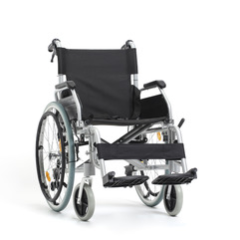
It has been one year since I became wheelchair bound. It was not a step back; rather it was the way to go forward with my mobility and my life.
My spine had progressively degenerated from older age: the vertebrae in my back which kept me erect and able to walk were collapsing on one another. When that happens, pain pervades the body. And everyday abilities, like walking, bathing, eating, writing, and dressing are robbed of the muscle and nerves, usually taken for granted, needed to do their job.
My doctors told me that any further progression of the degeneration of my spine would place me at high risk to become a paraplegic or - were that to be what happens - (preferably) to die.
I required neurosurgery. First and foremost, on the cervical (neck) vertebrae that were beginning to compress my spinal nerve in that region, which would destroy the nerve’s capacity to stimulate movement and sensation in my arms and hands.
Miracle #1: my surgeon and his entourage had told me they could stop the progressive spinal nerve compression, but I would not recover the precious abilities beginning to leave me, especially the feelings in and actions of my arms, hands, and fingers. But several hours after a lengthy operation when the bilateral surgical holes in my neck were closed, I awoke, with not-so-bad pain, hidden under diminishing doses of anesthesia. But something had changed: I could use my arms, hands, and fingers, not abiding to my surgeon’s prediction. I kept using my restored abilities to prove they were real and lasting, even after the anesthesia wore off and my pain returned.
Miracle #2: I began my recovery in the Mayo Clinic’s adjacent physical rehabilitation hospital, where I remained for 3 months. Upon admission, I could not walk, let alone stand. When asked my goals by my Rehab coordinator, I said, to safely and confidently walk using a walker, and return home by car (not ambulance) by learning to transfer from a wheelchair to a car. Each day I did 3 hours of rehab (more sometimes). After another 2 months I surprised myself by standing with a walker.
But I was not going anywhere (soon) because I became feverish. I had contracted MHRSA, the hospital borne infection that ruins everyone’s day.
Miracle #3 was surviving another bad chain of events, including a pneumonia, and 3 back surgeries to treat infections. After very good, coordinated medical care and a lot of physical therapy work I was able to return home, moving about with a walker. I was still a bit unsteady, but I was still alive and going home. I could type (!), walk aided by a walker, and see our grandkids at my home and theirs. I stopped praying that God would take me during the night.
As discharge from Rehab approached, I graduated from a walker to a wheelchair. Which meant that with help I could go places and return (somewhat) to the world I had known, instead of living in an 8’x10’ room in a rehab center. Bless the nurses who so ably and kindly cared for me.
No doubt about it: I was a disabled person. My life, full of people, places, and responsibilities (like the teaching I loved) had gone from a full bucket to one with a little water just visible at its bottom. I felt like I had been hit in the head with bat; what remained were slivers of that ‘Louisville Slugger’.
People are nice and courteous to a person, like me, in a wheelchair and having tipped the scale of age to 80. At least in New Hampshire, where I live. Even children are taught to give way. Nice, but I still had the problem of being unable to walk. The only way to stand and move my legs was more and more physical therapy, which hurts and delivers its results as if by a pipette. It truly helps to have a ‘team’ of family and friends cheering. As well as able and kind nurses (bless them, they are the heart of hospital services). A constitution built not to quit comes in handy.
While a wheelchair may offer some hope, it is indifferent to my plight, which also does respond to anti-depressants. A good psychotherapist knows about loss and shame, how to direct those feelings to fuel recovery, and how to keep people like me facing the facts without beating ourselves up too much.
Being unable to continue a life and career of abundance is hard to swallow if it's you, or me. Isolation, with its toxic loneliness, may be the greatest danger. That’s why, I suppose, so many support groups have proliferated. “Peer” support groups mean on the same rough road as me, whose members are living with the same pain and loss as I am. These fellow disabled people are learning to not let our catastrophic life events f__k us up.
Were you to look at my bio you might want to say to me ‘all good things come to an end’. What am I kvetching about? I don’t suggest you try to find out.
As has been said, “only the dead have seen an end to war”. I’m not dead (yet). I can still hear the roar of my life’s ‘battlefield cannons’. Once again they draw me in. For all the times in the past few years I prayed for God to take me in my sleep, I no longer did.
Living can be rich with love and joy. But getting there takes chomping hard on the’ bit’ called trying. No giving up. By seizing what is possible, notwithstanding the vertiginous ups and downs and tears and smiles, you can rediscover what you have lost. That’s why it was worth trying.
Lloyd I Sederer MD is a psychiatrist, public health doctor, and non-fiction writer.
Many of his writings and talks are available on his website, www.askdrlloyd.com



Comments